Drone-assisted site security

An aerial view to support your security team

Planned site checks and post-alert assessment, designed around your existing security procedures.

Drone observation can complement fixed cameras and on-site security teams. It can help staff review designated areas, assess the location of an alert and obtain visual information to support decisions about the appropriate response.

Duplitec starts with the task: we align the drone, docking station and monitoring solution with your site, existing systems and operating procedures. The level of automation depends on the selected system, site conditions and permitted operations.

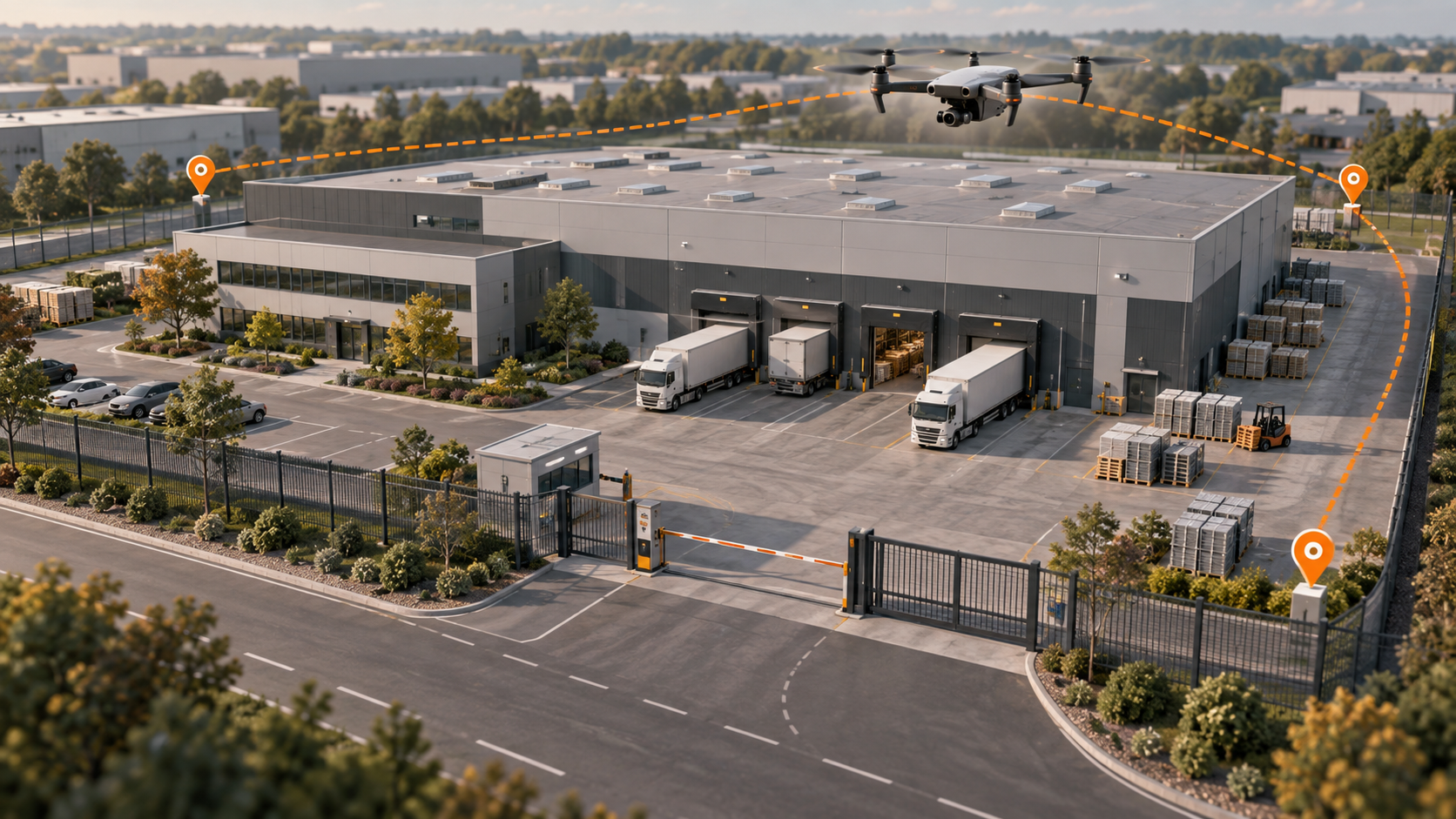
Concept illustration of drone-assisted inspection at an industrial site, with a route and observation points.

AI concept illustration; not an actual installation or a DJI product photograph.

Discuss your site with us DJI Dock equipment and technical details
What tasks can it support?

Three typical site tasks

  • Planned site checks. Visits to designated routes and observation points, aligned with the site's inspection schedule. Recorded imagery can help staff review changes and unusual situations.
  • Post-alert assessment. An aerial check of the reported area can provide additional visual information for the security team. The launch method and any required human approval are defined in an agreed procedure.
  • Checks of areas with limited visibility. Inspection of large yards, fence sections and areas around buildings within the limits of flight and observation conditions. Actual coverage must be planned through a site assessment.
How does the process work?

Four steps of an inspection

  1. Task or alert. A check may originate from the operating plan or an event assessed by an operator. Receiving an external alarm requires an appropriately configured integration.
  2. Conditions check. System status, weather, site conditions and the requirements for the specific operation must be checked before launch. Required operator decisions are defined in the operating procedures.
  3. Aerial assessment. The drone collects visual information for the assigned task. Live-view availability depends on the equipment and data connection; the designated person decides what action to take.
  4. Closure and review. The operation is closed in accordance with the agreed procedure. Access to recordings, retention and event documentation must be configured around the organisation's data handling and operating rules.
How does it connect to existing systems?

We design the drone solution to work alongside the site's existing cameras, alarm signals and monitoring workflows. We first establish what information or signal needs to be shared, who handles the event and where the aerial view should be displayed.

  • Video monitoring: we assess options for displaying imagery and associating it with an event.
  • Alarm handling: we agree on the signal source, launch conditions and the role of human approval.
  • Network and access: we plan the data connection, access roles and the required scope of logging.
  • Connection loss or downtime: we define when an operation cannot start and what alternative procedure the security team should follow.

Integration is not identical for every system. Supported interfaces, software versions and any required licences are checked for the specific configuration.

System integration options

01

Task or alert

02

Conditions check

03

Aerial assessment

04

Closure and review

The aerial view is one source of information for site monitoring.
Concept illustration; the actual system configuration depends on the site.
From site assessment to operation

A working solution needs clearly defined tasks, responsibilities and site conditions alongside the equipment. Duplitec supports deployment from needs assessment and system design through training and technical support.

  • Needs and site assessment: areas to be checked, existing cameras and alerts, observation needs and potential installation points.
  • System design and preparation: equipment selection, power supply, data connectivity, access roles, operator responsibilities and the conditions for use.
  • Installation and trial operation: configuration of the ordered system, testing the agreed inspection workflows and refining the setup based on the results.
  • Training and support: operator preparation, maintenance, servicing and updates within the agreed service scope.

Tell us which areas you want to inspect and which systems are already in place. We will use this information to agree on the next step.

Request a site assessment